The Fanling Universe · Ur, Ancient Sumer
Dumu
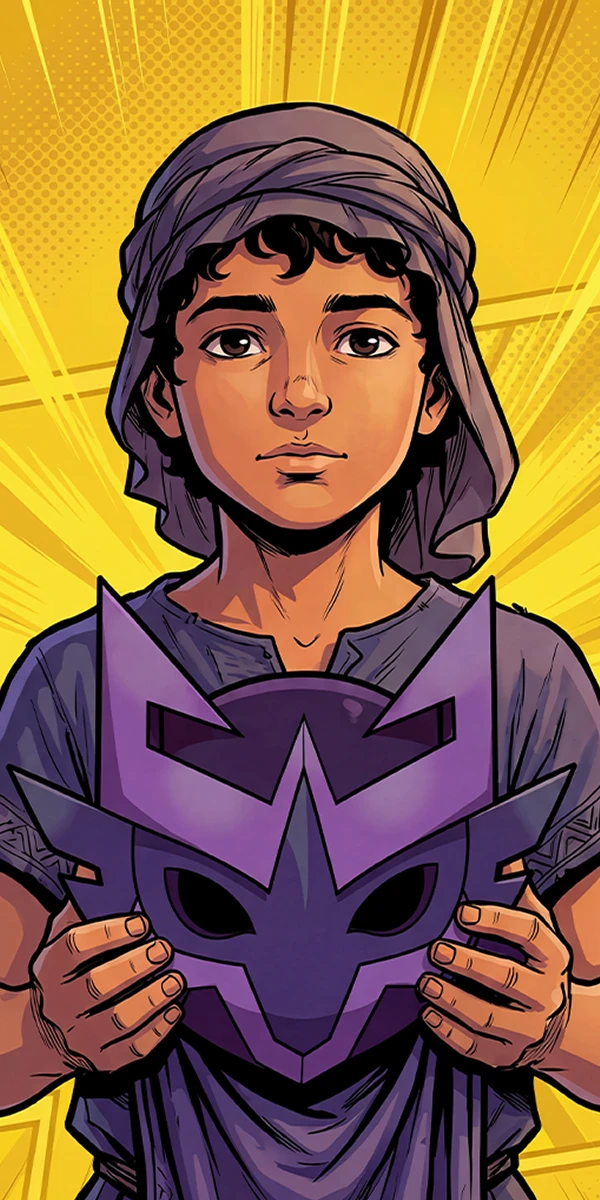
He Is Still Playing. He Never Stopped.
First Appearance: 2025 · The Mask of Dumu · Dumu of Ur
The Fanling Universe · Ur, Ancient Sumer
He Is Still Playing. He Never Stopped.
First Appearance: 2025 · The Mask of Dumu · Dumu of Ur
The Child
Not a marker of age. A description of something permanent.
Dumu. That was his name. It meant "child" in the Sumerian tongue, and it had been given to him honestly — because that is what he was. Not as a marker of age. As a description of something permanent. An openness. An unguardedness. That way of meeting the world that most of us carry for a few brief years and then quietly hand back.
Dumu never handed it back.
He was twelve years old in the ancient city of Ur. He could speak only a handful of words. People heard his halting syllables and thought they were hearing all of him. They were hearing the edge of a cathedral.
His inner world was built on the Epic of Gilgamesh — which he didn't just retell, but broke apart and rebuilt. Added characters. Sent them on new journeys. Changed the endings. Placed himself inside the narratives through his figures. If he'd been born in your time, he'd have been the kid building a sprawling universe in his bedroom while the world assumed he was doing nothing.
"He was twelve years old. His hands were older."
— The Mask of Dumu, Chapter OneThe Dark Stone
His father brought it home like an afterthought. It was the most important thing he would ever possess.
The crystal arrived wrapped in rough cloth among trade goods — black, not just dark, black in a way that swallowed whatever light touched it and gave nothing back. Most people could have held it and felt nothing. Set it on a shelf and never thought of it again.
When Dumu's eyes found it across the room, his entire being changed.
One touch of his fingertips against the surface — brief enough his father never stirred — and the mask blazed to life behind his eyes. Not a variation. Not another in the long lineage of figures he'd been carving since childhood. The source. The original. The one that every figure had been reaching toward without arriving.
"The mask was complete in his mind. The crystal was the only thing that could hold it. And the crystal would not yield."
— The Mask of Dumu, Chapter EightHe turned to the one tool he'd avoided: his father's silver hammer. Too fine for real work. A gift from the best years of a man's life. Dumu knew what it meant. He used it anyway. The thing inside him demanding to exist was more real than the pain.
The Silver Hammer
Nobody saw the mask taking shape. Nobody knew what it cost.
Dumu was a boy who could be undone by a dropped pot. Who could be folded in half by a shout. Who needed his mother beside him just to endure the ordinary noise of the marketplace.
Now he was producing, by his own hand, a sound that hit him like a fist — over and over, for hours, for months. The ringing of silver against crystal, sharp and piercing, cutting through walls with every blow.
The crystal demanded not just effort but emotional precision. When frustration swamped his focus, the line went wrong. When grief overtook him, the curves broke. When he struck in anger, he marred what he'd already shaped.
And yet he always began again. Would sit on the floor with the damaged mask in his lap, ears ringing, hands shaking, and whisper to the stone as though it could hear him.
"Tears on its dark surface. Then he'd lift the hammer again."
— The Mask of Dumu, Chapter EightThe sounds that had tormented him his whole life — his father's shouting, the crash of anger — those had always been sounds done to him. This was different. This was a sound Dumu was choosing. For the first time, he was the one deciding.
The Crossing
Amar came home on a day when the wind carried sand. He found the mask, and the ruined silver hammer on the floor beside it. He tore the mask from Dumu's arms and raised it — not to strike the mask. To strike Ama.
The mask refused. It grew impossibly heavy. As though every tear, every whisper, every fragment of spirit Dumu had poured into the crystal during those months of secret agony rose at once. The stone remembered who made it. It would not participate in harming what those hands loved.
Light erupted from the place where mask met skin — not fire, not lightning. Something older. It filled the room the way water fills a valley. The ground trembled. The air hummed with the same tone Dumu had heard when he first touched the crystal — but vast now, enormous, no longer a sound but a presence.
When the light cleared, Dumu was gone.
This was not Dumu transformed. He went somewhere. Through the mask, past it, beyond it — into a place that existed above this world the way the sky exists above the ground. The same boy, the same hands. A room large enough for every story he'd ever imagined. Amar ran into the night and never came back. Ama looked at the shadow filling her home and saw, simply, her son.
The Other Side
He never stopped playing. The scale just changed.
Somewhere beyond the membrane of this world, a child sits with his characters and plays — and the game is everything that will ever happen. His figures are no longer stone. They are living people, scattered across time, and the stories he moves them through are not imagined anymore. They are history.
The mask is how he reaches through. It is his hand extending into the world he left, placing itself where it needs to go — choosing who will wear it next, the same way he once chose to hand a bone-masked figure to a starving man in a marketplace. The same instinct. The same recognition. The same quiet certainty of a boy who sees someone's story and says, without words, because words were never his language: you belong in mine.
Not everyone who wears the mask is taken to the other side. Every encounter is unique. The mask is a mirror, and what it reflects depends entirely on who is looking into it. Some people are changed in ways they can't articulate. Some are given visions. Some are broken by what they see. And some — very few — go through, and don't come back.
The Keeper
The Keeper · The Watcher · The Witness
"I was the man from the marketplace. The one crouching against the wall behind the baskets. The one Dumu saw when no one else did."
Marrow is the narrator of Dumu's story and its last remaining witness. He was a starving man — reduced, as though life had been subtracting from him for so long that what was left barely constituted a person. Dumu saw him. Crossed the market, stood before him, and held out a figure carved from bone. Recognition, not pity.
Dumu placed Marrow in his story that day. And Dumu's story does not operate on the same terms as the rest of reality. Marrow's body did not age. He watched everyone around him grow old and die, and he remained — skin and bone, same as ever — carrying the bone-masked figure in his pocket, warm from a boy's hand, five thousand years and counting.
He is still here. The mask is still out there. This is not the end. It's not even the middle.
Explore the Universe
The heart of the Fanlings. Playful, expressive, and deeply connected to community.
Meet every spirit of creativity and freedom in the Fanling Universe.
Dive into the mythology and history behind the world the Fanlings inhabit.
Every character. Every world. The full Fanward universe in one place.